
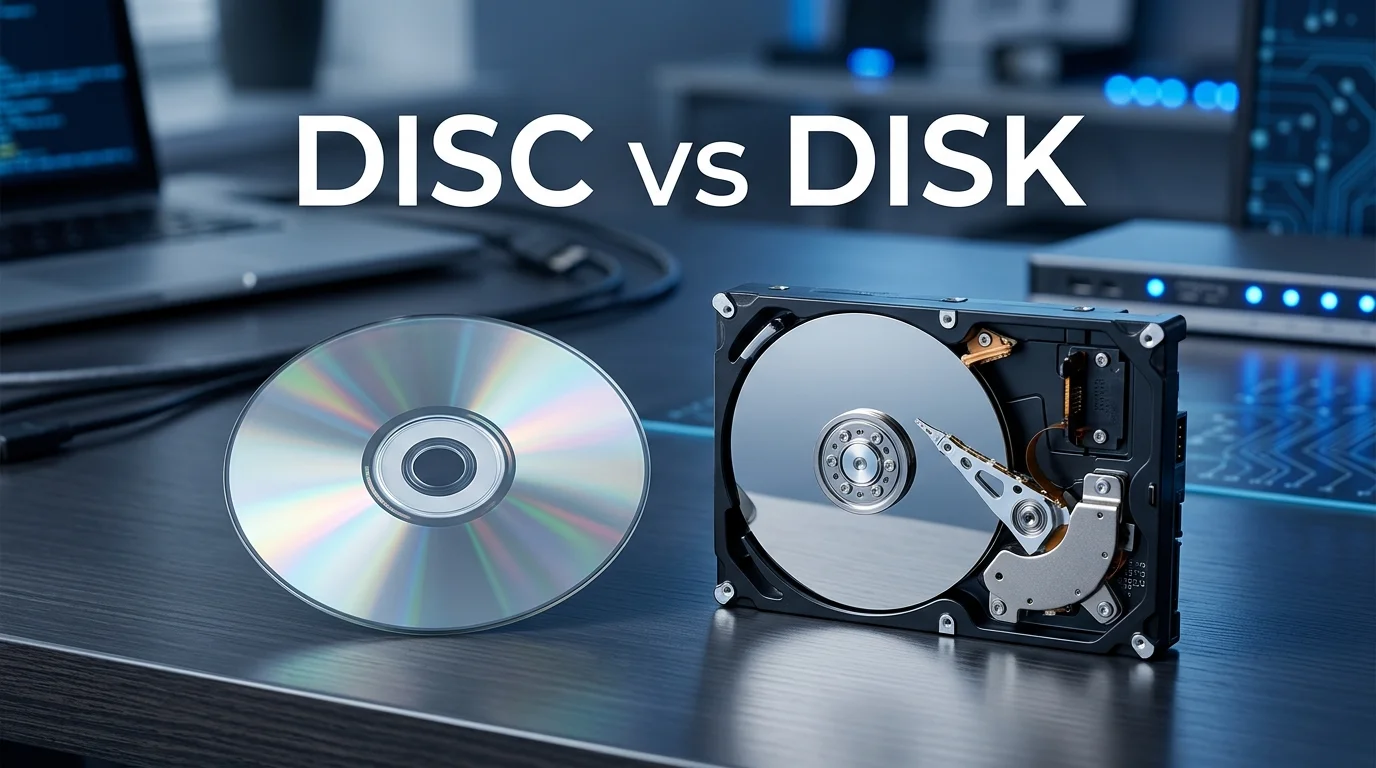
If disc vs disk leaves you wondering which spelling is correct, the answer depends on context. Both spellings are valid, but American English generally favors “disk” for computers and many general uses. “Disc” remains standard for optical media and several established terms.
Quick answer: Use “disk” for hard disks, floppy disks, disk drives, disk space, and most computer storage terms. Use “disc” for CDs, DVDs, Blu-ray Discs, disc golf, disc brakes, and disc jockeys. For general American writing, “disk” is usually the safer default when no established phrase applies.
| Context | Preferred US spelling | Common example |
|---|---|---|
| Computer storage | Disk | Hard disk |
| Windows storage tools | Disk | Disk Management |
| Optical media | Disc | Compact disc |
| DVDs and Blu-ray | Disc | Blu-ray Disc |
| Music | Disc | Disc jockey |
| Sports | Disc | Disc golf |
| Automotive brakes | Disc | Disc brakes |
| General round object | Usually disk | Circular disk |
| Medical terminology | Varies | Herniated disk / intervertebral disc |
Key Takeaways
- Both spellings are legitimate English words.
- American English generally favors disk as the default spelling.
- Computer storage terminology normally uses disk.
- CDs, DVDs, and Blu-ray media normally use disc.
- Several established expressions keep “disc,” even in American English.
- Medical usage varies by term and professional style.
- Context matters more than choosing one spelling everywhere.
What Is the Difference Between Disc vs Disk?
The two words share the same pronunciation and broadly describe flat, round objects. Their modern distinction comes mostly from established usage rather than different basic definitions. Technology provides the clearest examples of these conventions.
Computer terminology strongly favors “disk” for storage devices and related software concepts. Microsoft calls its Windows storage utility “Disk Management,” for example. The same spelling appears in terms such as hard disk, disk partition, and disk space.
Optical media follow another convention and normally use “disc.” A compact disc is a CD, while DVDs and Blu-ray media also follow the “disc” convention. This distinction remains useful even though optical media are less common today.
When Should You Use “Disk” in American English?
For a U.S. audience, “disk” is usually the correct choice for computer storage terminology. Windows documentation consistently uses terms including disk, hard disk, and Disk Management. This convention makes technical writing easier to recognize and understand.
Use “disk” for these common technology terms:
- hard disk
- hard disk drive
- floppy disk
- disk drive
- disk space
- disk image
- disk partition
- disk formatting
- startup disk
- virtual disk
- Disk Management
Suppose your computer warns that storage space is running low. You would normally say the computer has insufficient “disk space,” not “disc space.” The spelling remains conventional even when the machine uses an SSD rather than a spinning hard drive.
That last example exposes an interesting quirk in modern computing. An SSD has no rotating magnetic platter, yet software may still describe storage using “disk” terminology. The word has survived in computing vocabulary beyond its original hardware association.
Technolf readers learning basic computer terminology can also review the site’s article explaining what a PC is and how its main components work. Storage is one of those core components. Understanding standard terminology makes specifications and operating-system menus easier to interpret.
When Should You Use “Disc”?
Use “disc” when referring to optical media and several established expressions. The best-known example is the compact disc, commonly shortened to CD. DVDs and Blu-ray Discs follow the same general spelling convention.
Common American expressions using “disc” include:
- compact disc
- optical disc
- Blu-ray Disc
- disc jockey
- disc golf
- flying disc
- disc brake
- brake disc
- optic disc
These expressions show why the U.S. rule cannot be reduced to “Americans always use disk.” American writers regularly use both forms. The surrounding subject usually determines which version looks natural.
Optical media provide the easiest memory aid. If a laser reads information from removable circular media, “disc” is usually the expected spelling. That rule covers CDs, DVDs, and Blu-ray media without requiring complicated grammar knowledge.
Disc or Disk for Computer Storage?
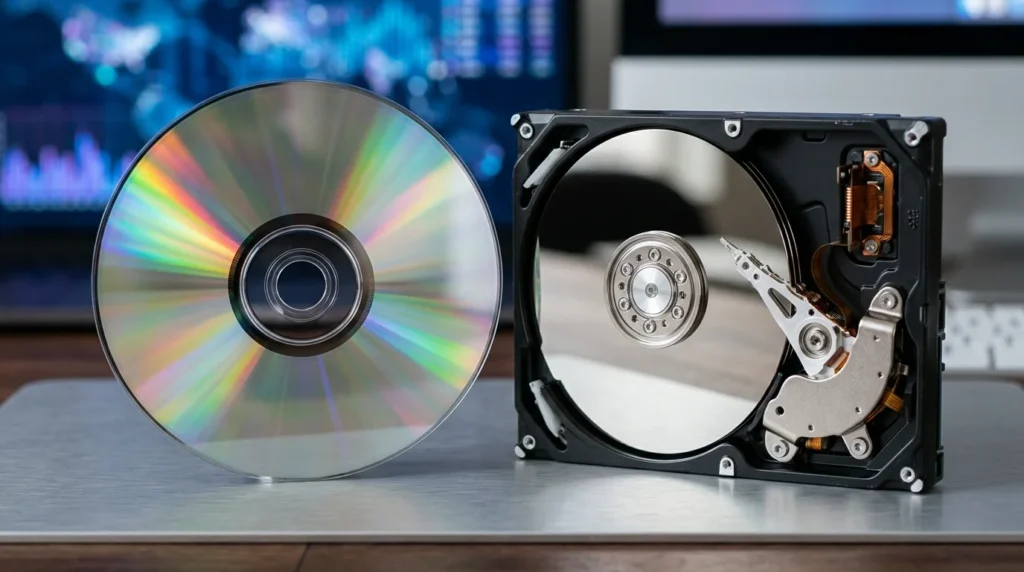
Use disk when discussing normal computer storage, storage management, partitions, or hard drives. This spelling appears throughout modern Windows terminology. It also remains familiar across the broader computing industry.
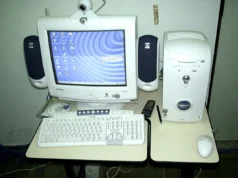
A traditional hard disk drive stores information on rotating magnetic platters. A floppy disk also uses magnetic storage, although that technology is now obsolete for everyday computing. These devices helped establish the spelling “disk” in computing.
An SSD works differently because it stores information in flash memory. Still, operating systems sometimes use older disk-related terminology for storage devices in general. That is why you may see “disk” menus on a computer with only solid-state storage.
If you are working with multiple screens and computer hardware, terminology can become confusing quickly. Technolf’s guide on connecting two monitors to a PC or laptop explains another common hardware setup. It covers ports, displays, docks, and operating-system settings.
Why Do CDs and DVDs Use “Disc”?
The optical-storage industry established “disc” as the familiar spelling for these media. The “D” in CD therefore means “disc,” not “disk.” The term compact disc became established long before streaming replaced much physical media use.
Optical media store information in a form that optical drives read with laser technology. CDs and DVDs are familiar examples, while Blu-ray uses related optical principles. Their spelling differs from the traditional “hard disk” convention.
You may therefore see both spellings in one technically correct sentence. For example, someone could copy files from a compact disc onto a hard disk. Each spelling identifies a familiar category without changing the pronunciation.
Is “Disk” Always American and “Disc” Always British?
No, regional spelling preference is only part of the explanation. American English generally favors “disk” for ordinary uses more than British English does. Established terminology can override that regional preference.
An American writer would still normally write “compact disc,” “disc golf,” and “disc jockey.” A British writer may also use “disk” for established computing expressions. Technology conventions often cross regional language boundaries.
For U.S. content, start with “disk” when no fixed expression tells you otherwise. Then check whether your subject has an established spelling. This approach produces more natural writing than applying one regional rule everywhere.
What About Medical Uses?
Medical spelling requires more care because both forms appear in American sources. “Herniated disk” is common in U.S. patient-facing language. Other anatomical expressions may retain “disc,” especially within particular medical specialties.
The eye provides a clear example because “optic disc” is an established anatomical term. Spinal terminology can vary between publishers and organizations. Writers should therefore follow the terminology used by their medical source or style guide.
Consistency matters, but accuracy matters more than forcing one spelling throughout a document. If an authoritative source names a specific structure or condition, preserve its terminology. That approach also reduces confusion for readers comparing your text with professional information.
A Simple Rule for Remembering Disk vs Disc
Think “disk for computer storage, disc for optical media.” This shortcut solves most technology-related spelling questions. You only need to remember several established exceptions outside computing.
Try these examples:
- Correct: My laptop is running out of disk space.
- Correct: The old desktop contains a hard disk drive.
- Correct: She found an old music disc.
- Correct: The software created a disk image.
- Correct: The movie came on a Blu-ray Disc.
- Correct: They played disc golf after work.
You can also remember the spelling through familiar abbreviations. CD means compact disc, so optical media provide a natural “C” reminder. Hard disk and disk drive then take the “K” spelling used throughout computing.
For more computer basics, Technolf’s PC Builders section covers hardware and setup topics. The site also explains small-office technology and storage considerations. Those resources can help place storage terminology in practical context.
Common Mistakes to Avoid
The first mistake is assuming one spelling is universally correct. Both words are legitimate, and established phrases determine many choices. Replacing every instance with one version can introduce errors rather than remove them.
The second mistake is writing “hard disc” in ordinary U.S. computer content. Readers will understand the phrase, but “hard disk” follows standard computing usage. Microsoft also uses the “disk” spelling throughout current Windows storage documentation.
Another common error is changing “compact disc” to “compact disk.” That spelling conflicts with the established name behind the abbreviation CD. Keep “disc” whenever you are referring specifically to compact discs.
Writers should also avoid assuming every modern storage device is technically a disk. SSDs store data electronically without spinning magnetic platters. Yet software interfaces may still use “disk” as a broader storage-management term.
Quick Decision Table for US Writers
| If you mean.. | Write.. | Example |
|---|---|---|
| Traditional computer storage | Disk | Hard disk |
| Storage capacity | Disk | Disk space |
| Windows storage utility | Disk | Disk Management |
| Floppy storage | Disk | Floppy disk |
| CD | Disc | Compact disc |
| DVD | Disc | DVD disc |
| Blu-ray media | Disc | Blu-ray Disc |
| Flying sports object | Disc | Flying disc |
| Golf equipment | Disc | Disc golf |
| Vehicle brake component | Disc | Disc brake |
| Eye anatomy | Disc | Optic disc |
| General US circular object | Usually disk | Metal disk |
Frequently Asked Questions
Is disc or disk correct in American English?
Both are correct, but American English generally uses “disk” as its default spelling. Established expressions such as compact disc and disc golf still use “disc.” The topic therefore matters more than a single universal spelling rule.
What is the difference between disc vs disk in computers?
“Disk” normally refers to computer storage terminology, including hard disks and disk space. “Disc” usually refers to optical media such as CDs, DVDs, and Blu-ray Discs. The distinction mainly comes from established industry conventions.
Is it hard disk or hard disc?
“Hard disk” is the standard form in American computer terminology. Microsoft uses “disk” in Windows features such as Disk Management. That spelling is the safest choice for U.S. technology content.
Is it compact disk or compact disc?
“Compact disc” is the established spelling. The abbreviation CD comes from the words “compact disc.” Using “disk” in that specific name is generally considered nonstandard.
Should I write disk or disc for an SSD?
Usually write “SSD” or “solid-state drive” when naming the hardware itself. An SSD contains no spinning magnetic platter. Software may still use broader terms such as disk space or disk management.
Why are both spellings still used?
English developed both spellings, while industries established their own naming conventions. Regional preferences also influenced everyday usage. Those conventions remained even as storage technology changed.
The Bottom Line
For U.S. readers, disk is the safest default for computing and many general references. Use disc for optical media and established expressions such as compact disc, disc golf, and disc jockey. Following the established phrase will usually give you the correct spelling.
The easiest technology rule is simple: hard disk, not hard disk. Check specialized terminology when writing about medicine, sports, or other fields. That habit keeps your wording accurate without memorizing dozens of exceptions.