
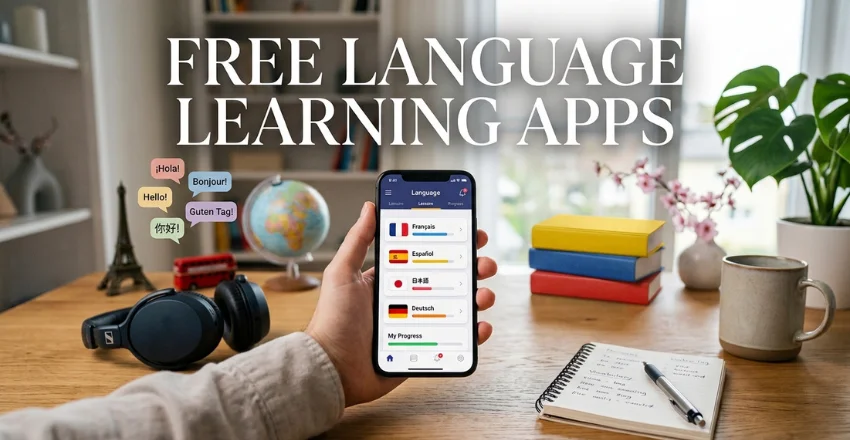
Learning a language does not require an immediate subscription. Several free language learning apps still offer useful lessons, vocabulary practice, or real conversation in 2026. The key is knowing which free tier matches your goal before you invest weeks in it.
Duolingo is the easiest all-purpose starting point for many beginners, while Language Transfer is stronger for ad-free audio study. HelloTalk is better for real conversation, and Mango can be excellent if your U.S. library provides access. Your choice should match your need for structure, vocabulary, speaking, or zero-cost access.
| App | Best for | What you can use free | Main limit |
|---|---|---|---|
| Duolingo | Daily beginner practice | Course content, short lessons, web and mobile access | Ads and possible Energy limits |
| Busuu | Structured courses | Course access, community feedback, basic progress tracking | Review tools and offline mode are paid |
| Memrise | Vocabulary and native-speaker video | Official courses, videos, tests, personalized reviews | Full feature set requires Pro |
| Language Transfer | Ad-free audio learning | Complete available audio courses | Smaller language catalog |
| Mango Languages | Library-card learners | Three sample lessons; full access through participating institutions | Full free access depends on your library or school |
| HelloTalk | Conversation practice | Voice and text exchange, Moments, Voicerooms | Some AI and translation tools have daily caps |
| Drops | Visual vocabulary | Five-minute sessions and 50+ languages | Five minutes every ten hours |
How We Chose These Free Language Learning Apps
We focused on services that offer ongoing value without requiring payment on day one. We also checked current vendor pages rather than relying on old app-store summaries. Each pick had to solve a clear problem, such as structure, vocabulary, listening, or speaking.
Free means different things across these services. Some provide a permanent free tier, while Language Transfer is donation-supported and fully free. Mango uses another model, because participating U.S. libraries and schools can cover full access.
We also considered how quickly a free limit can interrupt a real study routine. A five-minute cap matters more to a serious learner than an occasional ad. A strong free tier should let you practice often enough to build a repeatable habit.
1. Duolingo: A Strong Starting Point for Daily Practice
Duolingo is our starting pick for beginners who need a simple daily routine. The company says all course content remains free, supported by ads and paid subscriptions. Duolingo has also tested an Energy system that can slow longer free sessions for some users.
Pros.
- Broad course access without paying for lessons
- Short sessions that fit busy schedules
- Available on mobile devices and the web
Cons.
- Ads can interrupt the study flow
- Energy or similar limits may affect long sessions
- Advanced AI practice sits in paid tiers
2. Busuu: Better for Learners Who Want a Structured Course
Busuu suits learners who want a clearer course path and community feedback. Its 2026 support page lists complete courses, community access, and basic progress tracking for free users. Grammar review, vocabulary review, offline mode, and ad-free study require a Premium plan.
Pros.
- Clear course progression
- Community feedback from other learners
- Complete courses listed on the free plan
Cons.
- Useful review tools require payment
- Offline study is a Premium feature
- Some advanced speaking features are paid
3. Memrise: Useful for Vocabulary and Real-Speaker Video
Memrise suits learners who want vocabulary connected to real-speaker videos. Its free plan includes official courses for 23 languages, video clips, tests, and personalized review plans. Pro adds broader feature access and removes ads, so frequent learners may notice upgrade prompts.
Pros.
- Real-speaker video helps with listening
- Personalized review supports vocabulary recall
- Progress sync works across devices
Cons.
- The full feature set requires Pro
- Free access is not the same as unlimited access
- Less suited to learners wanting a textbook-style grammar path
4. Language Transfer: The Clearest Fully Free Choice
Language Transfer is the clearest fully free choice in this comparison. The app says it requires no sign-up, has no ads, and charges nothing for its audio courses. Its main tradeoff is breadth, because the catalog is smaller than major commercial platforms. Streaming those lessons still needs a steady connection, so Technolf’s guide to fixing slow internet is worth a look if downloads stall before a study session.
Pros.
- No subscription or advertising
- Strong focus on understanding language patterns
- Audio can be downloaded for offline listening
Cons.
- Fewer languages than large competitors
- Audio-first lessons may not suit visual learners
- Some courses are introductions rather than complete programs
5. Mango Languages: A Smart Pick for U.S. Library Cardholders

Mango is especially relevant for U.S. learners with a public library card. Anyone can sample three lessons, while participating libraries and schools can provide full access without a personal subscription. Mango says its catalog covers more than 70 languages, though free eligibility depends on your institution.
Pros.
- Full access can be free through participating libraries
- Large language catalog
- Lessons include conversation and cultural context
Cons.
- Library availability varies by ZIP code and institution
- Direct personal access is not fully free
- You may need a valid library or school login
6. HelloTalk: Best for Real Conversation Practice
HelloTalk is the strongest fit here for learners who need real conversation rather than structured lessons. Its free tier includes unlimited voice and text exchange, Moments corrections, Voicerooms, and basic partner matching. Translation, AI correction, and voice-to-text have daily caps, while some filters stay behind VIP.
Pros.
- Real conversations with native speakers
- Voice, text, and community correction tools
- Core exchange features remain free
Cons.
- Partner quality and response rates vary
- Some convenience tools have daily limits
- It does not replace a structured beginner course
7. Drops: Good for Five-Minute Vocabulary Sessions
Drops works well for visual vocabulary practice in short bursts. Free users can study for five minutes every ten hours, with more than 50 languages available. Topics open gradually, so the free version suits habit building better than long study sessions.
Pros.
- Visual vocabulary practice
- Large language selection
- Short sessions reduce time pressure
Cons.
- Five-minute free sessions are restrictive
- Topic access opens gradually
- It is not a complete speaking course
Which App Should You Start With?
For most beginners, start with Duolingo or Busuu for a repeatable course path. Choose Language Transfer when zero ads and zero payment matter more than catalog size. Add HelloTalk after you can form basic sentences and want regular interaction.
If your library offers Mango, try that access before paying for another structured service. Memrise works well as a vocabulary and listening companion, while Drops fits short review sessions. You do not need seven apps, because two complementary tools usually create a simpler routine.
How to Build a Better Free Study Setup
Start by defining one measurable goal for the next eight weeks. You might target travel phrases, family conversation, or a beginner course level. A clear target makes it easier to reject features that do not support your purpose.
Keep notes outside the app when you want to save corrections, phrases, or grammar patterns. Technolf’s guide to the best note-taking apps can help you compare study-friendly tools for that job. A separate note system also prevents useful examples from disappearing inside app histories.
Your device matters less than consistency, but a comfortable screen can improve longer study sessions. Technolf’s guide to laptops for business and personal use covers options for students and everyday users. Most of the services here also work on phones, so you don’t need new hardware.
Audio and video tools depend on a stable connection unless they support downloads. Fixing a weak home connection is usually cheaper than switching services. Language Transfer is useful here because downloaded audio can continue without a live connection.
Are Paid Plans Worth It?
A paid plan makes sense when a specific free limit blocks a habit you already follow. Paying for offline access can help commuters, while unlimited review may help intensive learners. Paying before you know your routine often buys features you rarely use.
Track the problem before upgrading. If ads annoy you but never stop a lesson, the free tier may still work. If conversation caps or review limits repeatedly interrupt practice, a paid plan becomes easier to justify.
Frequently Asked Questions
Which free language learning apps are completely free?
Language Transfer is fully free, with no ads, sign-up requirement, or subscription. Most other picks use freemium limits or paid upgrades. Mango can also provide full access when a participating library or school covers your account.
Is Duolingo really free in 2026?
Yes, Duolingo says its course content remains available without payment. Free users may see ads and usage systems such as Energy, depending on the account. Super and Max add convenience and advanced features, not basic course access.
Can a free app make me fluent?
A free app can build vocabulary, listening skill, and a strong beginner foundation. Fluency usually also requires extended listening, reading, writing, and real conversations. Combining a structured course with speaking practice creates broader exposure than one app alone.
Which free option is best for speaking practice?
HelloTalk is the strongest choice in this list for direct conversation with other people. Its core voice and text exchanges remain available without payment. Beginners may still want Busuu, Duolingo, or Language Transfer for structured learning before longer conversations.
Final Recommendation
Choose one foundation tool and one practice tool, then use both for eight weeks. Duolingo or Busuu can provide structure, while HelloTalk adds real interaction. Language Transfer is an excellent alternative when you want a fully free, ad-free course.
U.S. learners should also check local library access before buying a subscription. Mango can become a high-value option when your library participates. Start with the free route that removes your biggest barrier, then upgrade only when a limit affects consistent study.